
Mission SOC 2: A Practical Readiness Guide for Smaller Businesses

This guide is drawn from OrbitalFire’s Customer Learning Series webinar “Mission SOC 2: What Smaller Businesses Need to Know,” featuring OrbitalFire CEO Reg Harnish. Watch the Recording, or read the full guide below.
If you sell software or services to larger organizations, you’ve probably been asked for your SOC 2 report. If you don’t have one, you may be losing deals you didn’t even know were at risk.
SOC 2 compliance has quietly become a standard vendor requirement across industries. Healthcare organizations, financial firms, and enterprise companies now routinely ask their technology vendors and service providers to provide a SOC 2 Type II report before signing contracts. For smaller businesses trying to grow into those relationships, “we don’t have one yet” is an increasingly expensive answer.
But SOC 2 is also one of the most mystified frameworks in the compliance world. Here’s what it actually is, who actually needs it, and what the path to readiness looks like for a smaller organization.
What SOC 2 Actually Is (and Isn’t)
SOC 2 is an independent audit of your controls — specifically, how your organization manages and protects customer data. It evaluates five Trust Service Criteria: security, availability, processing integrity, confidentiality, and privacy. In practice, the Security criterion is almost always included; the rest depend on your scope and what your customers need to see.
There are three SOC reports. SOC 1 covers financial controls — the descendant of the old SAS 70, not relevant to cybersecurity conversations. SOC 3 is essentially a public-facing summary that says the audit happened. SOC 2 is the one that matters: a detailed report on your information security controls, issued by an independent CPA firm.
What SOC 2 is not: a government mandate, a single passing score, or a one-time certification. It’s an audit opinion.
Within SOC 2, there are two types. Type I is a point-in-time assessment — the auditor looks at your controls as of a specific date and confirms they’re designed appropriately. It’s faster and less expensive, but it doesn’t tell anyone whether those controls actually worked over time. Type II covers a defined period, typically six to twelve months. This is what most enterprise and mid-market buyers mean when they say “SOC 2 report,” and it’s what carries the most credibility.
A common path for organizations starting from scratch: get a Type I first to establish your controls, then run a Type II audit over the following six to twelve months.
What Surprises Most Organizations About SOC 2
This is the part most people don’t expect: a SOC 2 audit is not just a cybersecurity audit.
Yes, it evaluates your security controls. It also evaluates HR processes, job descriptions, background check procedures, board meeting minutes, change management policies, and vendor contracts. If you have a policy, the auditor wants to see it. If you have a process, they want evidence that you follow it. This isn’t bureaucracy for its own sake — all of those things have direct connections to how security actually works in an organization — but it means the scope of a real SOC 2 engagement is broader than most people expect.
The organizations that go through a genuine SOC 2 audit almost always learn something material about their own business. That’s one of the underrated benefits of the process. This is not what you’d call a vanity certification. The auditors find gaps that matter.
Who Needs SOC 2
Not every smaller business needs SOC 2. The question is whether your customer base is moving toward requiring it.
SOC 2 is most commonly required from technology vendors and SaaS companies whose software processes, stores, or transmits customer data. Managed service providers and organizations with deep access to client environments face increasing requests as well. If your customers are in healthcare, financial services, or defense, their own compliance obligations push security requirements down to their vendor relationships — and SOC 2 is one way they manage that.
If none of your customers are asking for it, SOC 2 may not be the right investment right now. A risk assessment will tell you more about where your actual gaps are.
What Controls Get Evaluated
The Security criterion breaks down into several areas: whether leadership takes security seriously and has documented policies; how the organization identifies and responds to risk; how changes to systems are managed; who can access systems, how that access is granted and revoked, and whether multi-factor authentication and access reviews are in place; how systems are monitored and incidents are handled; and how vendor risks are managed.
The operative word throughout is evidence. Auditors don’t take your word for it. They look for logs, screenshots, tickets, and records that show controls running consistently over the audit period.
Getting to Ready: The Real Timeline
Here’s the thing most organizations underestimate before they start: this takes longer than you think.
The process runs in five phases. Scoping takes about a month — you’re making decisions about what systems and services fall inside the audit boundary. Readiness assessment comes next, and this is the most time-consuming phase, typically three to six months. For each control in scope, you’re asking: do you have this in place? Is there evidence of it? Every no is a gap that needs to be closed before the audit window opens.
Then comes the audit window itself — a minimum of six months for a Type II, usually twelve. And here’s what surprises people: you’re not waiting during this period. You’re actively collecting evidence every month. Access reviews need to happen and be documented. Vulnerability scans need to run and be recorded. Change management needs to follow process and leave a paper trail. After the window closes, the reporting phase runs another two to four months.
Add it up and the end-to-end timeline — from the decision to pursue a Type II report to the day you hold one — is typically nine to eighteen months for a smaller organization.
One factor that speeds things up significantly: if you’re already aligned with a framework like HIPAA or NIST 800-171, you probably have many of the controls in place. The SOC 2 audit becomes more of a documentation and evidence exercise than a controls-implementation exercise.
Getting the Auditor Involved Early
One lesson that consistently comes up with organizations going through this process: get the auditor involved before you think you need them.
Auditors have specific expectations about how controls get documented and evidenced. If they tell you in month three that they want access reviews documented a certain way, and you’ve been doing them differently for six months, you’re redoing work. If they tell you that at the start, you do it right the first time.
What to Do With the Report Once You Have It
The SOC 2 report has three main uses once it exists.
The first is responding to vendor questionnaires. When a large customer sends a 300-question security questionnaire, you send your SOC 2 report instead. In many cases, the report closes the questionnaire entirely — it answers the underlying question about whether you’ve built a security program.
The second is sales conversations. Some enterprise customers won’t contract with vendors who can’t demonstrate a cybersecurity program. The SOC 2 report moves the conversation past “do you have security?” to “here’s what ours looks like.”
The third is internal. The gap findings from the readiness and audit process give you a prioritized list of things to work on. Organizations often find, once the report exists, that the internal value of knowing where the gaps are is worth more than the compliance piece.
Ready to figure out whether SOC 2 is the right next step for your organization? We’re Here to Chat
Frequently Asked Questions About SOC 2 for Smaller Businesses
What is a SOC 2 report?
A SOC 2 report is an independent audit opinion from a CPA firm that evaluates how an organization manages security, availability, and related controls for the systems it uses to serve customers. It covers the design and operation of your security controls over a defined period (Type II) or at a point in time (Type I). It’s not a certification or a pass/fail grade; it’s a detailed report that your customers review to assess whether they trust your security practices.
Do small businesses need SOC 2 compliance?
Only if their customers are asking for it or if they’re pursuing contracts where it’s required. SOC 2 is most commonly required from technology vendors, managed service providers, and organizations in regulated industry supply chains. If you sell to enterprise or mid-market buyers in healthcare, financial services, or defense, the requirement is increasingly likely. If your customer base doesn’t include those segments, a risk assessment may be a better starting point.
How long does it take to get SOC 2 certified?
SOC 2 is an audit report rather than a certification, but the path from starting to having a Type II report in hand typically takes nine to eighteen months for a smaller organization — including scope definition, readiness work, the audit window itself (minimum six months), and the reporting period. Organizations with existing HIPAA or NIST-based security programs often move faster due to significant overlap between the frameworks.
How much does a SOC 2 audit cost?
Audit costs vary based on scope and the size of your environment. For smaller organizations, Type I audits typically range from $15,000 to $40,000; Type II audits from $30,000 to $80,000 or more. Working with a cybersecurity advisor before engaging an auditor can reduce total cost by closing gaps before the audit clock starts.
What’s the difference between SOC 2 and ISO 27001?
SOC 2 is a U.S.-based audit report defined by the AICPA, commonly required by North American enterprise buyers. ISO 27001 is an international standard with a certification model, more common in European and global enterprise relationships. The underlying controls overlap significantly. Organizations focused on the North American market typically prioritize SOC 2 first.
What controls do I need for SOC 2?
For the foundational Security criterion, expect to need documented security policies, access controls with multi-factor authentication, regular access reviews and deprovisioning processes, incident response procedures, vendor risk management, change management controls, and system monitoring — all with evidence. A readiness assessment maps your current state against what’s required and identifies what to build before the audit period begins.
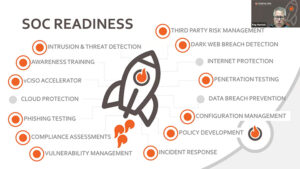
Watch the Full Recording: MISSION SOC 2: What Smaller Businesses Need to Know
Suggested Reading: “Do I Really Need That?” and Other Common Cybersecurity Questions from Small Businesses

You May Also Like